


Origami
-
Posts
21,584 -
Joined
-
Last visited
Content Type
Profiles
Forums
Gallery
Events
Store
Everything posted by Origami
-
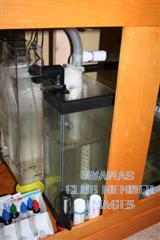
From the album: 90G Aquarium
-
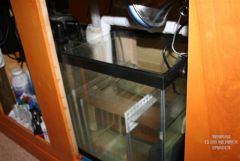
From the album: 90G Aquarium
-
I've done something very wrong with my closed loop it seems.
Origami replied to CHUBAKAH's topic in Do It Yourself
Correct me if I'm wrong here, Erik, but the point of failure of the 2x4 is not the same as the point where the system fails. The threshold of system failure would be when the 2x4's deflect enough to cause the tank to fail (break). The tank would fail due to small deflections far earlier than the 2x4's themselves (in which case the 2x4 would never really break, would it?). Here's the link to the curve for your pump: http://www.panworldamericas.com/PX/60Hz/A3400468.pdf. It looks like with 10' of loss (due mostly to twists & turns, with no allowance for vertical lift since this is closed loop), you're looking at about 507 gph out. That's about 125 gph from each outlet if equally divided. -
what else can I use to hold frags to rocks
Origami replied to jnguyen4007's topic in General Discussion
You can find aquamend in the adhesives area, typically near the paint department at HD. I sandwich a disk of it between two dollops of super glue (CA) gel before placing it on a frag plug or rock. The epoxy putty forms nicely to the rock shape but doesn't stick very well unless you use the gel or shove it into a hole. You might try using the CA gel trick on that stuff you threw out last night.... It might save you $14. -
Definitely it was snorkeling and diving over the reefs in Okinawa back in the mid-70's. The colors, shapes, and diversity of life was incredible. Since then, I've always longed to to have my own little corner of the reef. I put off satisfying that dream until my other financial priorities were taken care of (such as paying for the house, paying for the kids' college expenses, etc.). Now that I'm finally there, I'm a bit older (so I guess I'm qualified to play now, eh?). On a side note, I had a chance to scuba off those same reefs about a year and a half ago. Definitely impressive, but not anywhere near the same as 30 years ago. Reefs are in decline worldwide.
-
Steve, give us some pics when you've got this set up. I'd like to see how you made out.
-
BRK carries uniseals.
-
Newfish, take traveller7's advice to heart. Feed meaty foods about the size of the anemone's mouth (probably about a cm cubed). Shrimp, fish, squid... whatever. You said you were using a turkey baster - that tells me that you may be feeding little stuff and the anemone may be starving. Place a cube of this larger food on the oral disk of the anemone about every other day and watch for a feeding response (the mouth will start to invert and the oral disk or tentacles will draw the food in toward the mouth). If you get a feeding response, continue feeding and look for an improvement in the health of the creature over a couple of weeks. Look for new tentacles growing and flowing. Don't be too concerned if you see the anemone cycle through inflation and deflation as much as a couple of times a day - that can be normal behavior. Good luck and let us know here if you observe a feeding response when you try those meaty chunks.
-
Bob, I'm ROFL now with the image of your fish admiring and preening themselves in front of the mirror. Thanks for a good start to the day!
-
Forrest, I'm not sure I'm in sync with your question here, but I use an aqualifter on my overflow box (which is similar to yours, but a CPR clone) to pull the air that gathers at the top of the box (which, as you found can slow flow considerably). I set mine up so that the aqualifter pulls the air out of the fitting at the top of the box and dumps it into the drain-side of the box, just inside the wall there so there's no net water loss in the "tube" and no real risk of the tube draining when the tank water level drops (such as during water changes). It seems to work pretty well.
-
how to clean glass at bottom of the tank?
Origami replied to bk_market's topic in General Discussion
I have both a short and long handled scraper. Actually, for some of the hard to clean and hard to reach places, I prefer the short handle- long arms approach because of the advantage you'll have with leverage and better positioning of the scraper. Just my two cents. -
Now I can finally say I have a mated pair
Origami replied to gastone's topic in Propagation and Breeding
Oh, talk about a sharp wit.... -
Hey Josh. Sorry to hear of the loss of your livestock. I've been following your posts for a while now but haven't really had anything to add. I'm kind of new to this myself, you see. I did a lot of reading on the subject about six years ago when I first considered getting into this hobby, but put it off when I felt that I didn't have the time or resources to put into the hobby. Josh, I can see that this incident is weighing on you a bit, and that's good. You seem to have a high level of enthusiasm which has propelled you into rushing things. It's probably good now that you've got something to hold you back and reinforce that things sometimes need to slow down to make things right. Please remember, as you go forward, you own the responsibility of doing your best for the life in your tank. Good luck.
-
I had a problem with Caulerpa mexicana that came in on my Gulf rock spreading across unabated across my display. At first, like you, I thought it added a nice look. Then it started to spread across everything. In the end, however, I won out. Every few days for over a month, I was in the tank picking at the runners and harvesting handfuls of the stuff using a bamboo skewer to help dislodge the plants. I also had a yellow tang and a coral beauty that picked at the stuff. After about a month, it seemed I had passed a critical point where the Caulerpa regeneration could not stand up to the predation, and finally it died out. Yeah, it did look nice and, yeah, it was useful for nutrient export, but it was just taking over. Overall, though, I'm glad it's gone.
-
Great stuff, James. Thanks! I like Dan's comment about this being a drag race... let r rip. Zoom zoom,
-
Bob, I've taken several of them out over the last few months. Hitchikers. The largest had a carapace probably about an inch across. Of course, it looked like an absolute monster through the display glass! Only in one case was I able to trap one (a slightly smaller one) by using a small water bottle with the top cut off and placed (inverted) back into the remaining base. The reason is, they are very cautious and stay close to a hole they can retreat into, and are beaten to the bait by a train of hungry hermits. And then, the only reason I was able to trap one using this trap was because I'd tied a string to the lip of the trap so that when one did wander into the trap (while I was watching, of course), a quick pull on the string would right the otherwise horizontal trap to bring my hairy crab friend home. I've had far more luck using the chop-stick method. This method requires skill, patience, and, at the right moment, speed. You basically keep a chop stick handy and when you spy one of the little buggers, you make a quick move and finish it off. Not elegant but, as I said, more effective than my trap. Good luck with yours.
-
Also, BG algae (cyanobacteria) can thrive on a number of energy/nutrient sources. Nitrates, phosphates, dissolved organic compounds (DOCs), light.... High phosphates, by the way, is typically indicative of overfeeding. High nitrates could also be the result of overfeeding, an immature biological filter (you did say that your friend's setup is new, right?), bioactivation of some other media such as bioballs, filter media, or filter socks, or an overstocked aquarium. In addition to your test results, it would be good to post your stocking list, too. What kind (depth) of sandbed is your friend running? Are they using filter socks? Or a canister filter of some sort? Bioballs in the sump? Are they skimming? What kind of skimmer? Overall flow in the setup?
-
Not to hijack but, Chip, are you saying that a kalk stirrer can't be expected to get Ca levels much above 350 or is this only on big tanks with a lot of corals?
-
Many primers already are cleaners. Prime then solvent weld ("glue"). You can get both at Lowe's or Home Depot. Someone in plumbing will be glad to help you.
-
Removing the bioballs, in the long run, is a good thing. The reason for advising the slow removal is because they provided a large base of aerobic bacteria that converted ammonia to nitrite and nitrite to nitrates. Because of the way they're built, you don't have the anaerobic bacteria population here, however, to break the nitrates down. That's why it all ends up in your water column. Now, when you remove the bioballs quickly, you remove some of your tank's capacity to deal with the ammonia and nitrite loads. While this might stop some of the nitrate production, it also removes some of the capacity to deal with the ammonia and nitrite. The consequence, then, can be an ammonia spike followed by a nitrite spike because the tank's biological filter (live rock and sand) has insufficient capacity (because it was not given the time to build up by removing the bioballs in stages). Going slow in this hobby is generally good advice. Unless there's a real crisis, it's easy to do more harm than good by making quick changes. Another thing to note. If your tank water was yellowed, it was probably because you had a buildup of dissolved organic compounds (DOCs) that could be the consequence of overfeeding, overstocking, or inadequate skimming. Carbon is often used to "polish" the water - removing some of these DOCs after skimming. Again, caution is advised, when clarifying yellowed water. If your water was significantly yellowed, then cleaning it up quickly can effectively deliver far more light into your tank than its inhabitants are used to, creating problems in the short term. You may want to consider backing off your photoperiod a bit and increasing it a little each day until you're back to where you want to be.
-
I suspect it's more likely the electromagnetic field surrounding the fluorescents that's coupling with the TDS meter's circuitry that's giving you the reading. Put the TDS meter up close to an incandescent bulb and you probably won't see the same effect. Strangely, though, my TDS meter doesn't do what you're describing - neither under my PC's or halides. I wonder if it would behave differently if you changed batteries?
-
Bioballs and your sponge filter are notorious contributors to high nitrates in the water column. Removing them is a good idea but do it in stages so that the biological filtration in your live rock and sand bed can develop to accomodate the extra load. Nitrates and DOCs (dissolved organic compounds) may be behind your cyano bloom. Apparently all new tanks go through it. I'm going through it myself now (hopefully at the tail end of it, too).
-
Where should I buy my 150W 10K HQI DE MH bulbs?
Origami replied to Origami's topic in General Discussion
My lighting is provided by a Coralife Aqualight Pro which an integrated system (2x 150W HQI MH, 2x 96W Actinic 03, plus 4x lunar LED) that uses HQI ballasts. Insofar as what is it I'd like to know about a comparison between Ushio and XM bulbs, it's this. You have to realize that this is my first time looking into bulbs, so I don't really have much of an idea of what's important and what's not - you know, sifting the wheat from the chaff as it were. The aesthetics of color are important and (what appears to me as) the crisp white of the stock bulbs that were provided by coralife in the fixture, when supplemented by the actinics, seemed pretty nice. PAR value seems to be an important figure of merit as well and I'm making the leap that PAR value is tied to coral growth when all other parameters are held constant. (I'll tell you though, I thought my coral growth rates were kind of slow until just lately when things seem to be almost visibly taking off from day to day, which by the way, is kinda cool to watch.) I'm sure that I'm oversimplifying. Another member here has a some extra Ushios. She's also running some XM bulbs and has offered to let me have a look at her setup to compare the bulbs and I'll probably take her up on it. (Just another example of the generous nature of this WAMAS community!) So, if you could maybe tell me what you think is important to you when evaluating MH replacements, I'm sure that I would benefit. So far, and I hope it's to my benefit, I've clearly decided to stay away from the $8 ebay specials because I haven't a clue of what I'd be getting and I have way too much invested in this hobby to compromise on something as important to the health of the ecosystem as lighting. -
You'll find several here who haven't had a problem. I found some recently in my 29g setup and promptly removed them because of stuff I'd read on garf.org, though (in my short exposure to the hobby) I've never seen the problem personally. However, here's a link to another forum thread where the author used to let asterina's live in his system, but regretted it as they started going after his zoas. Pix are included in the thread. http://www.club-zoa.com/forums/showthread.php?t=7213 It appears that some people have a problem and others don't. This author states that they had begun to "overrun" his tank and preying on his zoas. It could be that, below a certain threshold, competition is light enough that preying on other sources such as corals is not required. That's just a guess, though. In any case, it would appear that you're not alone.
-
Where should I buy my 150W 10K HQI DE MH bulbs?
Origami replied to Origami's topic in General Discussion
Jamal, I just started my tank out last September. I've got a number of SPS frags sitting mid to high in the tank. A couple of montipora (green and orange), a pink birdsnest, bali green slimer, an acropora, and a green christmas tree something-or-other frag from Dave Lin (I'm going to have to look that name up again, I guess). Down low, I have some mushrooms and a couple of GSP frags. I also have a couple of anemones that have done very well - a flower anemone which is now a good 7 inches across and a purple condylactis which is at least that large. The flower sits about 3/4 of the way up and the condy is about 1/4 of the way up from the bottom. Both seem to like where they're at as they don't move much (the flower anemone, in fact, has only moved about 2-1/2 inches over the last 5 months or so). Really, though, I'd like to add more SPS if I can and get decent growth. Where can I find more information out on the XM's and the Ushio's? There doesn't seem to be any really recent studies by S. Joshi on 150W halides in the last 3 years or so. Interesting that you run your bulbs for a year plus. Metelsky, in Simplified Reefkeeping, recommends a 6 month cycle saying that while the light looks OK to us, the aged light color shifts month-to-month and should be replaced. Kent-Marine also says, "Replace metal halide bulbs every 6 months or so, and fluorescents every 12 months " on their website at http://www.kentmarine.com/kent-university/reef-lighting.htm. Other people also talk about replacing bulbs at longer intervals (1 year typical but sometimes more). One site even went so far as to say to replace the halides when they began to flicker (that would seem to be pretty far along the age path, you'd think). So, besides telling me a little bit more about XM's, presuming that I wait a few months to replace my bulbs, what are the in's and out's of doing so? What do I have to look out for? Should I back off the photo period or do something else to ease the corals into the new lighting?