
Origami
-
Posts
21,584 -
Joined
-
Last visited
Content Type
Profiles
Forums
Gallery
Events
Store
Everything posted by Origami
-
how long to keep a powder blue tang in jail?
Origami replied to astroboy's topic in General Discussion
It's not so much the size of the tank that concerns me, but the fact that they're both Acanthurus species and, therefore, aggression between the two will be more pronounced than between other tang species. If you can physically subdivide the tank for a couple of weeks to give the new inhabitant time to see the Powder Blue and to exchange chemistry (scent) with the other inhabitants, you may reduce the aggression. (I recall Copps doing something similar when introducing a new conspecific marine angel into one of his old (much smaller) tanks.) Otherwise, you may have to arrange or add some rockwork to break sight-lines and provide cover for the newcomer who's more likely to be bullied, even to the point of death. -
Happy to do so. PM your email to me. Sent from my Note 10+5g using Tapatalk
-
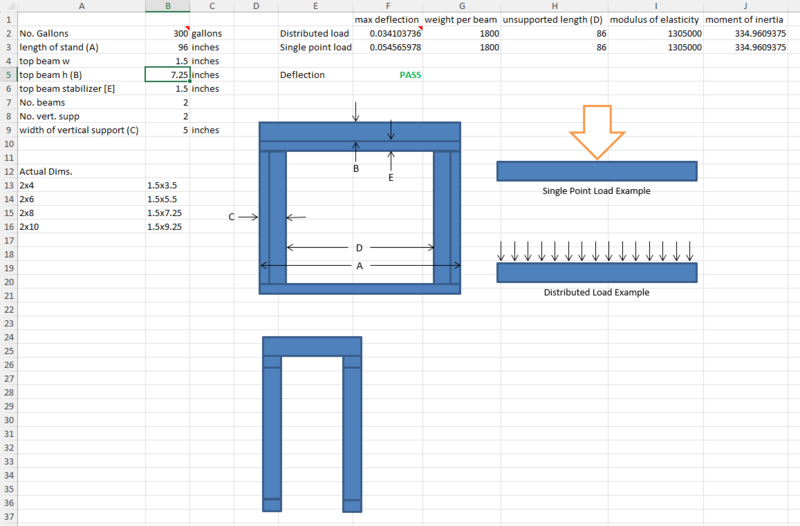
Yes, just use 2x8 beams. No center post required. But note that there's an extra 1. 5 inches under the beams from the top stabilizer. This gives extra support for the vertical load, while providing some stability against warping (sort of like an i-beam). Sent from my Note 10+5g using Tapatalk
-
Here's an old thread that might be worth taking a look at, @liquidgsr, too.
-
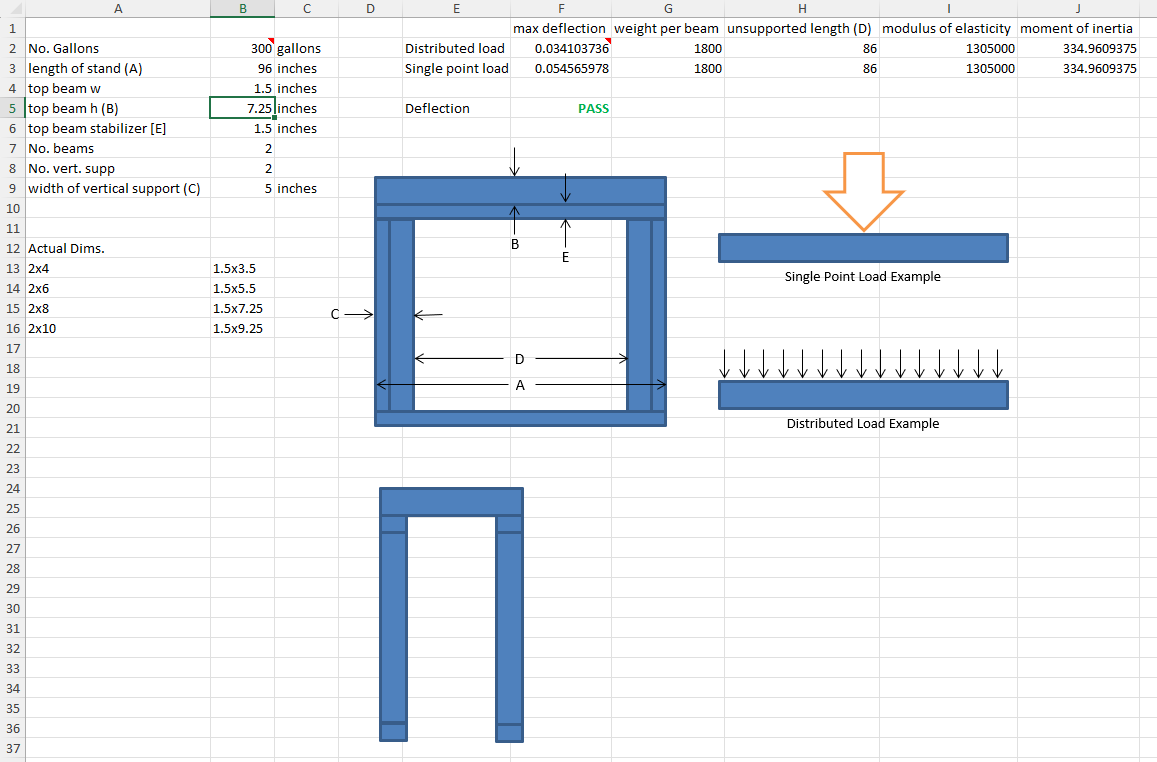
Brobak, this is snapshot of a beam deflection calculator that I used in the past to design my in-wall tank setup over ten years ago. Its purpose was to validate the beam deflection and therefore beam size needed to meet my goal of having two posts (one at either end of the beam to maximize access underneath the tank. First, I want to point out that my beam construction actually uses a main beam plus a 2x4 oriented horizontally to stabilize the beam from horizontal warping. You'll see that in the drawing. I'll also note that I addeda 3/4" plywood top, not shown. The legs in my (72") stand are constructed of two 2x4's arranged perpendicularly along their long edge and mounted to a 2x4 baseplate fastened to the concrete floor. The front of the stand is fastened into the wall studs to provide stability against racking. My 220 gallon tank sits 41 inches off the ground with this design using oversized 2x6's as the main beam. I've run the numbers for this design extended to your 96" - 300 gallon tank and it'll work with 2x6 beams, but I'd recommend that you go with the 2x8 for the added margin if you choose to go this route. Also, for safety's sake, given the long legs, I'd upgrade the top beam stabilizer, base plate, and legs to 2x6's. The calculation shows the beam deflection under the distributed load of the tank (estimated at 3600 pounds total) should be less than 1/20" using this design. Hope this isn't too late and that it helps.
-
You'll be fine with the configuration you describe. Sent from my Note 10+5g using Tapatalk
-
Welcome. I hope that you find your stay here rewarding. It sounds like you took your time cycling your tank. That's good. It's hard to say why your Montipora is suffering. Guessing about iodine or calcium deficiency, and then acting on that isn't a good idea, though. You really need to test. I suggest five core tests to start: First: Salinity. Get a refractometer, calibrate it, and measure your salinity. Second: Temperature. Next: Calcium and Alkalinity are two of the most important ions to measure. And finally, measure your magnesium. Note that I didn't include phosphate, nitrate, potassium, or anything else. Not that these are without value, but because these are the most basic water parameters to track. Test using quality test kits and post what you've found. Regarding your wrasse, how long did you have it before it died? Did you follow any sort of quarantine protocol before adding it to your tank? Sent from my Note 10+5g using Tapatalk
-
Confirm it looks like cyanobacteria. Is it less obvious just before lights turn on in the morning? Cyano can photosynthesize, so it tends to get worse as the day progresses. Sent from my Note 10+5g using Tapatalk
-
Ha, yes. An old thread, indeed. Sent from my Note 10+5g using Tapatalk
-
c02 scrubber, skimmer, and Milwaukee MC122
Origami replied to BowieReefer84's topic in General Discussion
I pull outside air into my skimmer as I run a calcium reactor. No CO2 scrubber, though. Has worked fine this way for over 10 years.. Sent from my Note 10+5g using Tapatalk -
Ze Frank "True Facts" has hit the reefs! Sent from my Note 10+5g using Tapatalk
-
Great review! Thanks. Marcos has been great supporter of the club and it's members both as a hobbyist and small business. Of late, he's been posting alot of new stuff in the ERC forum. Definitely worth checking out. Or, if you want to be notified when any of our club sponsors post about new stuff, subscribing to their WAMAS forum. Sent from my Note 10+5g using Tapatalk
-
If it's a deposit, then it's likely a strong acid solution will dissolve it. Put the tank on its side and add the acidic solution and let it set awhile. Heat might help move the process along. On the other hand, if the glass is etched or the deposit is tightly bound in microscopic pores, you might be able to remove the haze using a polishing bob and a fine glass polish like cerium oxide. It's hard work and can take awhile. Don't go crazy, though, if you polish too much in one spot, it's possible to introduce slight distortions in the glass if you don't polish evenly. I've found, though, that once you have water in the tank, these deposits largely disappear from view. Sent from my Note 10+5g using Tapatalk
-
I'm glad you're settled in, Dave. You're old engineer goby is doing just fine. Best of luck in NM. Sent from my Note 10+5g using Tapatalk
-
SUPER SALE TO CLEAR OUT QT - POWDER BLUE TANGS!
Origami replied to monkiboy's topic in Exotic Reef Creations
Gorgeous! Sent from my Note 10+5g using Tapatalk -
Super! So happy it went well! Sent from my Note 10+5g using Tapatalk
-
What's the best way to start dosing kalk??
Origami replied to tonkadawg's topic in General Discussion
I'd probably start by adding 1 cup to the stirrer. As the kalk dissolves (remember, only run fresh water thru a kalk stirrer), it's level (depth) drops. Add more as needed. See how much you consume in 1 week. Typically, I'd advise you to keep no more than 10 days worth of kalk in the reactor at any one time to avoid a really disastrous spill should that occur. Other precautions you can take include limiting the rate / volume of water that the reactor can deliver by using a peristaltic pump; never tying the reactor directly to your Rodi system, monitoring your pH and shutting down the stirrer feed if pH climbs too high. Sent from my Note 10+5g using Tapatalk -
Good luck to the participants! Sent from my Note 10+5g using Tapatalk
-
And yet another donation to the raffle courtesy of our wonderful sponsor, Reed Mariculture (maker of Reef Nutrition products)! Alexie over at Reed has generously provided... One gift card valued at $100 (plus an additional $40 to cover shipping costs) AND Two more gift cards valued at $50 (plus an additional $40 each to cover shipping). These are great products that, once you've tried them, you're bound to love. Our most sincere thanks to Nancy and Reed Mariculture for their generous support!



-
Salinity is on target at 35 ppt. Ammonia and nitrite are both zero. That's good. Nitrate looks to be about 20 ppm. That's OK. Alk is 9.75 dKH which is on the high side of the normal range, so OK. Calcium is a tad on the high side, but OK given the higher alkalinity concentration. Phosphate is just high of the normally acceptable range but, given the 20 ppm nitrate, this should drop as nutrients are taken up. All in all, these numbers are good. As long as any other pollutants that we're previously discussed are under control, things will hopefully be better. Sent from my Note 10+5g using Tapatalk
-
DaJMasta's right. The refractometer is reading really high compared to your conductance meter. A high reading might explain the high alkalinity and calcium (depending upon whose salt your using). Calibrate the refractometer with a marine saltwater standard and let's see what that turns up. Your phosphates are still very high and may make keeping some corals difficult for you.
-
Getting out of the hobby and selling 75 gallon reef setup!
Origami replied to Csteer's topic in General Discussion
Courtesy bump after adding pictures to the original post for the seller. -
Your alkalinity (174 ppm CaCO3 = 9.78 dKH) is acceptable for a reef tank, but kind of high if you were going FOWLR (fish only with live rock). Your calcium is a bit on the high side, too. Acceptable, but high for my tastes. Your phosphate level is on the high side, too (170 ppb or 0.170 ppm). OK for FOWLR, but kind of nutrient-rich for a typical reef tank. Do you have a calibrated refractometer that you can measure salinity with? Sent from my Note 10+5g using Tapatalk
-
Great news, Hilary. I'm so glad that the scholarship that we funded (and you spearheaded) will help students at NSU for many, many years to come. Its great to get a report like this, too. Sent from my Note 10+5g using Tapatalk
-
Getting out of the hobby and selling 75 gallon reef setup!
Origami replied to Csteer's topic in General Discussion
Charlotte, let me PM you and I'll help you with getting a picture added to your post.