


Origami
-
Posts
21,584 -
Joined
-
Last visited
Content Type
Profiles
Forums
Gallery
Events
Store
Everything posted by Origami
-
By the way, your combo meter reports that your salinity is 1.022. That's a bit low for corals (target 1.0264 or 35 ppt), but quite sufficient for fish.
-
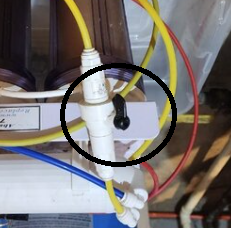
The flush valve on your RO/DI unit is positioned wrong. When it's pointed along the length of the valve, it's set up to flush the membrane. It's supposed to be at a right angle to the body during RO production. To produce RO/DI water in your configuration, position the valve in the position shown for a few minutes (while not collecting water from the DI side) and then set the valve cross-wise. Start collecting water about a minute after you've set the valve in this new position. Take a sample and, with a clean tds sensor (rinse the contacts off in fresh water since you don't want salt residue on the contacts when you test), take a TDS measurement. Report back on the number.
-
Put up a picture of your RO/DI setup, too. Sent from my Note 10+5g using Tapatalk
-
A 4 dKH spike in a matter of hours is high and 11.7 dKH is on the high side of normal. You can go too high, but unless you're running a ULNS (ultra-low nutrient system), higher alk (>8 dKH) should not cause great harm. Shut down your dosing and let consumption bring your levels down. Here's something that I posted back in 2009 about responding to a kalk overdose.
-
Super low PAR - how long to acclimate increase?
Origami replied to beatle's topic in General Discussion
I think that your target and timeline are ideal. For that level of par shifting, I think I wouldn't aim any faster than 2-3 weeks. I think that 4 weeks reflects much-demanded and much-respected patience. Rather than a linear ramp, you could aim for something that were more proportional. Example using a roughly 22% increase per week over 4 weeks: Week 1: 45% to 55% Week 2: 55% to 67% Week 3: 67% to 82% Week 4: 82% to 100% (or target) -
So, when you submitted your freshwater sample for the ATI test, did you take the water from the 30 gallon trash can or directly from the RO/DI? Do you have a TDS (total dissolved solids) meter? (One normally comes with the RO/DI if bought new.) If so, have you tested the TDS output of the water coming directly from the RO/DI unit? To do this: Start RO/DI water production and let it run for several (>4) minutes. Take a sample into a really clean, dry cup (glass, for example) Measure TDS You're on a well. So am I. (My whole house water filtering consists of particulate filtering - mostly clay solids - and a water softener.) High CO2 is pretty common in well water and will deplete your anion resin (the part of the DI stage that removes negatively charged ions like dissolved CO2 (which becomes HCO3- and CO3--)) very quickly. Sometimes in as little as 100 gallons of water production overall can deplete all of your anion resin - just from the amount of (otherwise harmless) dissolved CO2 in the water. But dissolved metal ions are positively charged and removed by your cation resin. So those leaking through would indicate that your anion resin is exhausted. This would be the case if the water coming directly out of your RO/DI were contaminated with metals. I would not be surprised if this were the case in Cheasapeake Beach - the high levels of silicon and aluminum probably matches the sand/sediments of your region, so finding it dissolved in your water might be logical. The other possible source of the metals would be the 30 gallon trashcan that you're using for mixing. (While I don't have all the metals that you do, I have low levels of nickel in my ground water - also discovered on an ATI test - that I deal with using a separate cation resin stage on my RO/DI.) I have no idea where the heavy metals are coming into your freshwater but apparently it's there. It's either coming up from the groundwater (lithium, for example, is common here in the States) or it's coming from something in your water handling/processing chain. I also don't know if that's a source of the problem you're seeing - I kind of doubt it. But, it may be something that you want to look into simply because it could be in your drinking water at home.
-
I saw this in the news today. Thanks for sharing it.
-
Your salinity is a touch low (1.024 sg), but not horrible. Most of us like to keep it a little higher (35 ppt or 1.0264 sg). You've got some metals in your water, too: Tin and Aluminum are notable. Manganese, too. They're also present in your fresh water sample. Silicon is also very high and appears to be coming from your fresh water. Where are you getting your fresh water that you're using to mix your saltwater? It seems to be the source of a lot (but not all) of the out-of-whack numbers in your tank water. How do you process and store your fresh water before using it? And, how do you move it from your fresh water vessel to your saltwater mixing vessel? If you're using an RO/DI setup, it seems that your cation resin is depleted as it's letting all these metal ions thru.
-
Great feedback! Sent from my Note 10+5g using Tapatalk
-
I'm in trouble. I haven't made a deliberate attempt to clean my sandbed in the 12 years that this tank has been set up. I just adopted a rather large engineer goby from a friend who is moving. He's been busy turning over the sanded at one end of the tank. No issues from his efforts, either. Though I now have nice white mounds of sand that he's cleared from the tunnels he's excavated. There are certainly issues with some deep sandbeds accumulating detritus or, worse, pockets of hydrogen sulfide. But I wouldn't be too quick to come to that conclusion. Sent from my Note 10+5g using Tapatalk
-
Off hand, it sounds like you both have been stung. My guess, in that case, is the torch coral. Especially if the bumps are localized. If each bump is at a hair follicle, though, it may be a bacterial infection. Were often pretty cavalier about reaching into our tanks and simply drying off. However, bacteria can thrive in the water column - and some can be rather harmful. For example, look up mycobacterium marinarum infections for an example. I believe John from BRK had an issue with it many years back. I may be misremembering, though. But somebody here did suffer from it. This is a good reminder. We all should consider washing with soap and water after reaching into our tanks. Sent from my Note 10+5g using Tapatalk
-
Looks like diatoms. Most all new tank setups go thru this phase. Normal. Sent from my Note 10+5g using Tapatalk
-
I like your concept of floating the tank in the wall. When I built out my basement, Phase 1 was my fish room. Priorities, you know. I tied into a wall that I built, with intentional reinforcement of the 2x4 wall structure to bear part of the tank weight. This framing serves as a sill allowing the front glass panel to lay flush with the wall. Someday, when breaking the system down, I'll have to pull some decorative trim on the room facing side and remove two 2x8's that jut out into the fish room (serving as side rails supporting the tank) before drywalling the opening closed. All of my equipment is in the room. None accessible from the front. However, I do leave openings in front above the tank to feed the fish from the front to make it easier to watch them eat. I plan to create doors for the openings but, years later, still haven't. My wife still occasionally asks me about it, though. Sent from my Note 10+5g using Tapatalk
-
Funny that you mention National Harbor. We looked at that, too, in 2015 and it was the most expensive venue of them all. I don't think that Tysons has the exhibition, banquet, and meeting floor space that's needed in any one facility. I could be wrong about that because so much has changed since I worked right in that area. Metrorail access to Dulles, National and DC make Tyson's a viable alternative if the floorspace and economics worked. If, after recent events, MACNA has to scale back and, if they bring back club competition/hosting, then perhaps DC would be viable again. After all, we're a premier tourist destination and that helps traveling attendees justify the trip, tacking on a few extra tourist days. We'll just have to see what a "re-architected" MACNA might look like in the future.
-
I'll give you my opinion as somebody pretty close to the planning of these events and some of the issues that surround it. The simple answer falls in the range of unlikely to no. The reason is convention-center economics. First-tier cities (e.g., NYC, San Francisco, Seattle, and, to some extent, DC) are very expensive. When we hosted the event in 2015, we explored using the DC Convention Center but, between the cost for the venue, hotel, and the food-and-beverage commitments, we deemed it prohibitively expensive to go there. Instead, we took the show to the Marriott Wardman Park near the National Zoo and used all three of their exhibition show rooms for the exhibitor show floor. We had low ceilings, carpeted floors, and the floor plan was complicated by having to subdivide into three very large rooms, some of which were oddly shaped, but we managed. In addition, this club really turned out to support the event with a greater base of MACNA volunteers than I have ever seen at MACNA. People loved and raved about how we were easy to find (volunteers wore a bright red t-shirt identifying them) and everywhere. So labor costs were limited to union-support for certain trades and for event security. And it was, at that point in time and perhaps even now, the largest, most-attended, and economically most successful MACNAs ever. But the convention-center model is a slightly different beast and, with relatively little competition in DC, still remains expensive. The event has, under the MASNA-managed model (in place since MACNA 2018) has relied somewhat less on local volunteers and filling some positions with paid, short term staff. These all increase costs that have to offset revenue. To close the gap, in a first-tier city, you have to rely on higher hotel costs, higher ticket prices, and higher exhibitor/sponsor costs AND increased attendance/foot traffic. It's difficult to do all that and that's the reason for why I think it would be unlikely that it would come back to DC proper (in the near term) using the Convention Center as the venue and the current MASNA-managed, convention center model. Again, just my thoughts.
-
I can still picture you at the volunteer coordinator's station in your red t-shirt. Thanks. Your effort and that of so many made the 2015 show a record-smashing success. Sent from my Note 10+5g using Tapatalk
-
That's coming. Ticket sales for 2023 have long been closed as what to do was considered. Similar for booth sales. Sent from my Note 10+5g using Tapatalk
-
Ha! The dangers of typing on my phone! Corrected. But 2014 (Denver) was definitely a success. As was ours in 2015. Sent from my Note 10+5g using Tapatalk
-
Let's bypass the rumors. For now, let's just say that success was looking very difficult to achieve in 2023. And, after 2 years of cancelations for the in-person event, and an underperforming Milwaukee event, that it is time to regroup and see if the next MACNA can return to meet it's high standards as well as attendee and exhibitor expectations. Pittsburgh wasn't looking like it could do that so, rather than further damage the brand, it was canceled and a new effort is being launched to make 2024 an unqualified success. Sent from my Note 10+5g using Tapatalk
-
Just out: The MASNA Board regrets to announce the cancellation of MACNA 2023 in Pittsburgh, PA. The Board is working on bringing MACNA back in 2024. Stay tuned as we re-craft the premier hobbyist-driven marine aquarium show in the US. Sent from my Note 10+5g using Tapatalk
-
By the way, the above quote is the voice of experience. I once had an acrylic 180 with eurobracing (like the tank in your picture but in standard 180 dimensions. When it came time to move, I couldn't get some of my larger colonies out of the tank (intact). So, knowing that I wasn't going to keep the tank anyway, I braced the top of the tank with wooden beams and bar clamps and, using a circular saw, cut most of the eurobracing out. Pretty extreme, but it worked.
-
A standard 120 is a better fit. But, if you're up for it, either get it with external overflows or drill and install them yourself. Depending on where you live, a member here may be able to help you with this if needed. Sent from my Note 10+5g using Tapatalk
-
I didn't realize that the 36-inch dimension on the acrylic tank was height. That tank is unsuitable for a reef in my opinion. The euro bracing on top leaves little room to move stuff in and out (especially if you have colonies growing on rock one day in the future) and will block a lot of light. Also, more depth means more water for light to have to penetrate. Plus, unless the light is fairly directive, you'll lose a lot of light to spillover. No, hard pass on that tank, too. Sent from my Note 10+5g using Tapatalk
-
Having owned both acrylic and glass displays, I'd never go back to acrylic. The main reason is keeping the panels clean and clear of coraline algae. If you're not on top of it all of the time, it's a royal pain to be armpit-deep with a hand scraper chipping away using a plastic scraper. However, on the plus-side, it's clearer and a lot lighter. And the tank you cited is 36" front to back, that gives a lot of room for aquascaping. Make sure that the panels are of an appropriate thickness or braced, otherwise the acrylic can bow outward. Flat bottom means putting the tank on a sheet of foam to distribute weight evenly. I prefer glass but the dual corner overflows take up too much space in the tank that you mentioned. It's also just 18" front to back. I wouldn't go for anything less than 24" front to back and definitely would prefer an external overflow box so I'm not taking up a lot of space with top-to-bottom overflows. Honestly, my thought here is to wait for something better in glass. But if you're set on one of these two, I'd go with the acrylic simply because of the extra front-to-back space. Just know that, with this tank, you'll have to really stay on top of the display-panel maintenance.
-
** !! INSTANT OCEAN IO/RC SALT SALE !! **
Origami replied to monkiboy's topic in Exotic Reef Creations
Moved topic to the ERC forum since (monkiboy/ERC) status has changed to Platinum Sponsor.