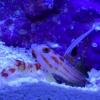
Nart October 3, 2017 October 3, 2017 (edited) Hello All, I am trying to help a friend figure out what this is on her rock. She started with dry rocks, so the only way we think it could have hitch-hiked in is by frag plugs. Please see attached. Any ideas? Thank you, Ben Edited October 3, 2017 by Nart
Jon Lazar October 3, 2017 October 3, 2017 Its hard to tell much from the pic, but its nothing I recognize. I'd try to narrow it down based on what you can observe. Does it behave like a coral? I mean, does it expand and contract throughout the day in response to light? Does it react when touched or otherwise disturbed? Is it soft like a soft coral, or more firm like a sponge? Does it have an open hole like a sponge or tunicate? Does it have common soft coral parts, like a central stalk and an oral disk? Sent from my SCH-I545 using Tapatalk
Nart October 4, 2017 Author October 4, 2017 @Jon Lazar this is how she describes it as.. "It's starting to look strangely like I'm looking up through a tiny hot air balloon.. if that makes sense at all. So, you see the petals? At the junction of each petal, a filament or string is stretched upward, and each of those strings comes together to form small ring above the main petal structure. It retracts when touched." Someone told her it's an encrusting tunicate. But it doesn't match the pictures when you search up encrusting tunicate. Maybe it's because of it's in the early stages?
mari.harutunian October 4, 2017 October 4, 2017 (edited) Try colonial tunicates. Sent from my iPhone using Tapatalk Edited October 4, 2017 by mari.harutunian
Nart October 4, 2017 Author October 4, 2017 Thanks Mari. I'll have her look it up to see if it matches. This is her response to @Jon Lazar questions: "It does behave like a coral in some aspects. Responds to light and retracts a bit when touched. One day it never opened, staying closed during all day even when lights were on. It was so tight and small it was hard to see. It did not look like a round closed polyp on a stem like zoa, more like a roundish, flattish, tiny bump on the rock then next day there were two of them. It's not firm like a sponge, more lacey and stringy. It does appear to have a central hole but there is no stalk or visible oral disc."
Origami October 4, 2017 October 4, 2017 Unless it's bothersome and spreading like a weed, it may pay to just watch it and see what it does. It's not obvious yet that it's a pest after all. Sometimes you find interesting things - even treasures - in this hobby from things that you don't recognize at first. Many years ago, I had a "scuff" on a rock that was about the size of a dime. I noticed it when pulling some rock out of my tank in preparation for a tank transfer. I kept (in my frag tank) it because it looked like some sort of living tissue and I wanted to see what it would become. This is what it looks like today (it's about 5" across): I had no idea what it was and reached out to Colin Foord (of Coral Morphologic), who identified it as a probable Indo-Pacific Mycedium. Sometimes it pays just to wait and see what develops.
YHSublime October 4, 2017 October 4, 2017 Your friend should join WAMAS, blackboard members are free.... and if they have a reef tank, its only the next logical step.
Nart October 5, 2017 Author October 5, 2017 Appreciate the help all. I would get her to join, but she's in Florida which she is currently looking for a local reef club after they get the whole Irma mess situated.
Jon Lazar October 8, 2017 October 8, 2017 Ben, I posted this on R2R in the creature ID forum to get additional ideas. Most responses were tunicate or bryozoan. Personally I think bryozoan is more likely because the picture shows a ring of tentacles. That's a feature that bryozoans have but tunicates lack. It could be helpful if you could get more pictures from a different angle that would reveal additional clues about the critter's body. Either way, the critters in your friend's tank are likely filter feeders without nematocysts. That means they probably won't sting nearby corals. It's always possible that they will eventually encroach on corals and irritate them, but I wouldn't worry about it. If it were my tank I'd leave them alone and enjoy watching a creature that's relatively rare and unknown in the hobby.
Nart October 9, 2017 Author October 9, 2017 @Jon Lazar thank you Jon. Appreciate the help! It does look like bryozoans. I'll pass on the info.


Recommended Posts
Create an account or sign in to comment
You need to be a member in order to leave a comment
Create an account
Sign up for a new account in our community. It's easy!
Register a new accountSign in
Already have an account? Sign in here.
Sign In Now